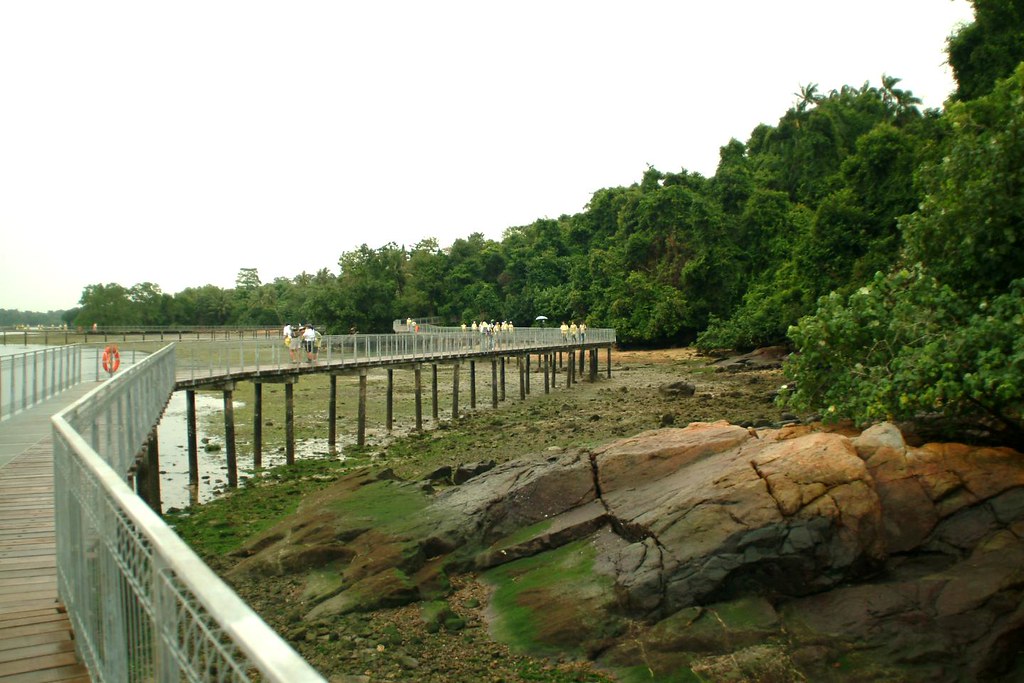
Terrestrial recce, Pulau Semakau, Singapore, 4th August 2007

Much has been known for Semakau's intertidal fauna and flora through the joint efforts by various parties, which concern about the biodiversity of the landfill island in the recent years, species of the terrestrial component are rarely reported. Species list of forest plants and birds have been listed, while that of invertebrates and other mammals almost remains unknown. As an attempt to fill this gap, Hung Kei, Hung Bun and myself form a volunteer survey team to recce the site, and to conduct a "quick and dirty" first hand data collection.


Starting point of the forest trail

To access coral reef beach of the island, everyone has to pass a forest trail. For those have been there, the density and the strength of mosquito bite are surely the unforgetable experiences. In many a time, people will just covered themselves with whatever means, or/and running through it so as to get less bites. But for us, we are aiming to survey this place, back and forth slowly looking for various kinds of insect and spiders. Those mosquitoes were happily enjoying their unexpected food source.

The recce trip is rewarded quite well with a list of of spider species, and some of insects which have been spotted....

Species list of spiders

Araneidae
1.Argiope cf perforata
2.Cyrtophora unicolor
Tetragnathidae
3.Tylorida striata
Theriidae
4.Achaearanea mundula
5.Achaearanea t-notata
6. Theridon sp (green)
Scytodidae
7.Scytodes fusca
Oxyopidae
8.Oxyopes birmanicus
9.Tapponia sp
Lycosidae
10.Pardosa sp
Salticidae
11.Epeus flavobilineatus
12.Thiania bhamoensis
13.Thorelliola ensifera
14.Cocalus murinus
15.Myrmarachne maxillosa
16.?Thianitara sp
17. sp1 (dog-faced jumper)
18. sp2 (long-tailed jumper)
Desidae
19.Desis cf martensi
Clubionidae
20.Clubiona sp1
21.Clubiona sp2 (elongated abdomen)
22.Clubiona sp3 (rounded abdomen, green)
Thomisidae
23.Thomisus sp
24.Tmarus pulchripes
25.Amyciaea lineatipes
Heteropodidae
26.Thelccticopis sp

List of Insects

Grasshopper
Cricket
Beetle
Leave beetle
Paired beetles
Ladybird
Black fly
Red-eyed fly
Micropezid fly
Weaver ants
Twig wilters
Robberflies
Leaf beetle
Common Grass Yellow Butterfly
Two species of Long legged fly
Two small moths
Squash bug and nymph
Praying mantis
Plataspid bug


Others

Snail
Gecko


References

Koh, K. H. 1989. A guide to common Singapore Spiders. Singapore Science Centre, Singapore, pp 1-160.

Murphy, F. & J. Murphy, 2000. An introduction to the spiders of South East Asia, with notes on all the genera. Malaysian Nature Society, Kuala Lumpur, Malaysia, pp 1-625, plates. 1-32.

Sime Road, Central Catchment Nature Reserve, Singapore 15th July 2007


This is the second time that I joined Kim Seng for the bird census. On 25th March this year, during the Annual Bird Census, I did learn a lot from him by coming along for the 3 hour walk. This year I even learnt more as we were lucky enough to sight a very good spot which is created by several naturally fallen trees. During about 20 minute stop there, we found more than 10 species of forest birds actively moving around and singing, including some that I have never seen before, namely the Asian Fairy-Bluebird, Red-Crowed Barbet, Chestnut-Bellied Malkoha and Red-Eyed Bulbul, etc. Kim Seng explained to me and Paul, the other assistant for the census, the various songs and their responsible singers. It's really a very nice experience that you hear a bird song and see the bird at the same time! In total, we encountered 35 species, with 184 individuals of birds. There are two black-naped oriole and several Yellow-vented Bulbul there also, which according to Kim Seng, is not a good sign for the habitat. Both species are normally found at open country area.


DSCF12_Blue Malayan Coral Snake (Maticora bivirgata) DSCF0003_Blue Malayan Coral Snake (Maticora bivirgata)

During the census, we came across a Blue Malayan Coral Snake. It was slowly moving from one side of the trail to the other. That gave me a sufficent time to take photos for it. But as it is so famous for its venomous bite, I dare not to go too close to it for a closeup. We also saw quite a number of dragonfly and damselfly species. So after the census, I spend another 2 hours walked again along the same trail to survey the dragonfly and damselfly. I tried to take photography records for most of the species. But several species were in limited number and located at some distance beyond my camera's reach. A painted bronzeback snake and a comon Sun Skink were also recorded. The following list is based on direct observation and photographs consulted with the guidebooks by Orr (2003, 2005).

Painted Bronzeback Common Sun Skink

Odonata species list for the day


1. Ceriagrion cerinorubellum (Brauer, 1865), common

2. Vestalis amoena (Hagen, 1853), common

3. Aciosoma panorpoides Rambur, 1842, common

4. Ictinogomphus decoratus melaenops (Selys, 1858), common

5. Neurothemis fluctuans (Fabricius, 1793), common

6. Orchithemis pulcherrima Brauer, 1878, blue morph, common

7. Brachydiplax chalybea Brauer, 1868, common

8. Orthetrum sabina (Drury, 1773), common

9. Orthetrum chrysis (Selys, 1891) male, commom

10. Rhyothemis phyllis (Sulzer, 1776), common

11. Rhyothemis triangularis Kirby, 1889, uncommon

12. Rhyothemis cf obsolescens Kirby, 1889, uncommon

13. Trithemis aurora (Burmeister, 1839), common

14. Tyriobapta torrida Kirby, 1889, common


DSCF0145_Pantala flavescens
Orchithemis pulcherrima, orange form

DSCF0142_Orchithemis pulcherrima
Orchithemis pulcherrima, dark form


DSCF0148_Acisoma panorpoides_male
Acisoma panorpoide, male

DSCF0134_Tyriobapta torrida

Tyriobapta torrida

DSCF0084_Orchithemis_pruinans.
Orchithemis pruinans


DSCF0074_Vestalis amoena
Vestalis amoena


References


Lim, K. K P & F. L. K. Lim, 1992. A guide to the amphibians and reptiles of Singapore. Singapore Science Centre, Singapore, pp1-160.

Lim, K. S. & Gardner, D. C., 1997. Bird, an Illustrated field guide to the birds of Singapore. Sun Tree Publishing, Singapore, pp 1-210.

Orr, A. G., 2005. Dragonflies of Peninsular Malaysia and Singapore. Natural History Publications (Borneo), Kata Kinabalu, pp. 1-125.

Orr, A. G., 2003. A guide to the dragonflies of Borneo, their identification and biology. Natural History Publications (Borneo), Kota Kinabalu, pp. 1-195.

Cheong, L. F., Checklist of Odonata in Singapore. (unpublished)

Chek Jawa, Pulau Ubin, Singapore 7th July 2007


The Chek Jawa Wetland was officially launched this morning. From now on, all visitors can come to visit Chek Jawa from 8am to 6pm, seven days a week, on their own. It's a raining day, and the launch have to be started at 8:30am due to the restricted tidal timing, as there will be a guided natural walk after the launch. Still, there was a large number of people, include government officers, volunteers and public visitors turn up. Singaporean are getting more and more enthusiastic and concern of the conservation of their nature and biodiversity. As to promote the visit of Chek Jawa Wetland, A 1.1 km boardwalk has been built along the coast. A gallery was set up on the previous British Colony House No.1 in Pulau Ubin to dispaly the diversity of life in Chek Jawa.

Moving along the boardwalk, visitors will be able to observe the variety of creatures underneath or next to it.
Compare to directly walking into the wet, you may feel that you are not so close to those marine creature. But on the other hand, you will be able to see these animals' behaviour in their nature way from such a boardwalk.


Start from the gallery, along the boardwalk, you will be able to see all kind of habitats that Chek Jawa provides. The rocky shore at the first half of the boardwalk, is probably the longest continue rocky habitat in Singapore.


Outside the boardwalk is an extensive sandy habitats, which holds a large patch of seagrass and its inhabitants. At the middle of the board walk, there is a floating board walk (like a pontoon) extending toward the sand bar. It will bring the visitor down a bit when the tide is lower, and hence provided a better view for the intertidal fauna and flora . The second half of the boardwalk is dominated by mangrove habitats. Here, mangrove fauna is not so rich as compared to Sungei Buloh and many of other mangrove sites in Singapore. But still, we were able to see and hear several species of birds during the one hour walk, namely straw-headed bulbul, common tailorbird, ashy tailorbird, common Iora, olive-backed sunbird, pied fantail and oriental magpie-robin. We even saw a large size of banded kraits (snake) moving slowly at the back mangrove. According to Lim and Lim (1992), "The kraits have seldom been encourtered in Singapore". Between the sand bar and mangrove, there is a sanddy-mudflat. Here, numerous fiddle crabs (Uca sp), sand bubbler crab (Scopimera sp) include several different species moving, waving, and fighting (or playing). Many individuals of a small mud-skipper caught visitor's eyes as they display a bizarre behavior. The fish keeps continuously jumping up and down to a distance about twice of its body length in a vertical position. No sure what they were doing, probably some kind of territorial display.
After the walk, I followed the local mangrove expert, Dr. Jean Yong and his students, together with Ali from Pulau Ubin station to other mangrove areas in Pulau Ubin to continue our adventure. One of locally endangered species of mangrove tree, currently has only very limited individuals in Singapore, and half of them are growing in the Pulau Ubin. Jean wanted to check the current situation of those trees. We penetrated slowly into a dense back mangrove forest, back and forth several times.

We could not located our target plants eventually as Jean and Ali did not remember well the exact location. So we may come another day to search it again. All of us end up very dirty and exhausted. I saw this passion fruit when we were searching in the forest. We also came across a young wild boar in distance.

We then have our late lunch at about 2:30pm. And during the lunch, while having the fruit, I saw a tiny spider moving on the surface of a ranbutan...


References

Lim, K. K P & F. L. K. Lim, 1992. A guide to the amphibians and reptiles of Singapore. Singapore Science Centre, Singapore, pp1-160.

Lim, K. S. & D. Gardner, 1990. Birds, an illustrated field guide to the birds of Singapore. Suntree, Singapore, pp 1-210.

Lorong Halus, Singapore, 4th July 2007


A visit to the Lorong Halus Pond and its vicinity at about 9am to 1pm...

My colleagues and I passed through Pasi Ris Farmway and stop at a canal just next to Loyang Agrotechnology Park. There were about 18 species of bird during an hour observation and count. I only manage to take photo for this big bird,the purpl heron, which is quite common there.


Purple heron (Ardea purpurea)

Before entering the small gate of the pone area, I came across this changeable lizard who was just doing his daily sun bathing.


This pond is famous for it inhabitant, Little Grebe (Tachybaptus ruficollis), an interesting species of native rare duck-shaped bird. Scanning through the pond surface with the binocular, we hardly can see the trace of little grebe. However, several Pacific swallows were happily playing on the top of an iron rod at the middle of the pond.


Pacific swallow (Hirundo tahitica)

Later through the binocular, we saw one pair of little grebe among the vegetation along the edge at the other side of the pond. So I walked along the edge of the pond, slowly moving toward them. I was sucessfully close enough to see two of them in details. But when I attempted to a photo, both were suddenly disappeared from my signt...

The little grebes are actually very shy bird, trying to keep a distance long enough from me by diving away underwater and surfacing in distance several minutes later.


There are quite a number of dragonflies and damselflies flying and perching among the grass at the edge of the pond.

Diplacodes_trivialis Diplacodes trivialis, close-up

Dragonfly Diplacodes trivialis

Damselflies are small in size but with a large number...

Ischnura senegalensis, male

Damselfly Ischnura senegalensis, male

Ischnura senegalensis, female

Damselfly Ischnura senegalensis, female

Then I saw a female fiercely grabed a male and the reaction of the male was like helpless for escaping away or doing any other things...


Mating or fighting? (1) Mating or fighting? (2)

Courship prior to copulation or fighting?

The pair were flying away before I can get more clues for what they are doing.

Later, I saw several mating pairs of damselflies flying and perching...

Ischnura senegalensis

Pair in the wheel, with male on top

Ischnura senegalensis, mating, close-up

Ischnura senegalensis, female, mating

According to Orr (2003), the mating process was normally leading by male who uses its anal appendages to grab the head or prothorax of the female. So at the end I still don't know what were happening to the prvious "fighting" pair.


References

Lim, K. S. & Gardner, D. C., 1997. Bird, an Illustrated field guide to the birds of Singapore. Sun Tree Publishing, Singapore, pp 1-210.

Orr, A. G., 2005. Dragonflies of Peninsular Malaysia and Singapore. Natural History Publications (Borneo), Kata Kinabalu, pp. 1-125.

Orr, A. G., 2003. A guide to the dragonflies of Borneo, their identification and biology. Natural History Publications (Borneo), Kota Kinabalu, pp. 1-195.